Placenta Develops From the Zygote or the Mother's Uterus Does the Placenta Develop Mom or Baby?
Placenta
The placenta is a fetomaternal organ. The fetal portion of the placenta is known every bit the villous chorion. The maternal portion is known equally the decidua basalis. The two portions are held together by anchoring villi that are anchored to the decidua basalis past the cytotrophoblastic beat out.
Decidua
The endometrium (lining of the uterus) of the mother is known as the decidua (�cast off�), consisting of three regions named past location.
Table seven - Regions of the Decidua
| Region | Clarification |
| Decidua basalis | Region between the blastocyst and the myometrium |
| Decidua capsularis | Endometrium that covers the implanted blastocyst |
| Decidua parietalis | All the remaining endometrium |
Equally the embryo enlarges, the decidua capsularis becomes stretched and smooth. Somewhen the decidua capsularis merges with the decidua parietalis, obliterating the uterine cavity.
Placental Membrane
Function
The placental membrane separates maternal blood from fetal blood. The fetal part of the placenta is known as the chorion. The maternal component of the placenta is known equally the decidua basalis.
� Oxygen and nutrients in the maternal claret in the intervillous spaces diffuse through the walls of the villi and enter the fetal capillaries.
� Carbon dioxide and waste product products diffuse from blood in the fetal capillaries through the walls of the villi to the maternal claret in the intervillous spaces.
The Placenta
Although the placental membrane is often referred to as the placental barrier, many substances, both helpful and harmful, can cross it to affect the developing embryo.
Structure
� Primary chorionic villi are solid outgrowths of cytotrophoblast that protrude into the syncytiotrophoblast.
� Secondary chorionic villi accept a core of loose connective tissue, which grows into the primary villi near the third week of development.
� Tertiary chorionic villi contain embryonic blood vessels that develop from mesenchymal cells in the loose connective tissue core. These claret vessels connect upward with vessels that develop in the chorion and connecting stem and brainstorm to circulate embryonic blood nearly the third week of development.
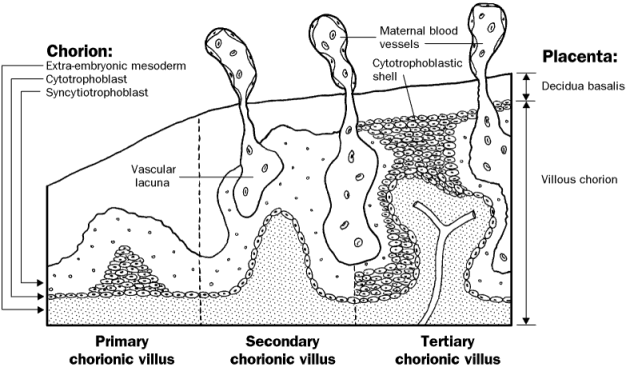
Figure 4 - Structure of placenta and chorionic villi
Table 8 - Substances that Cantankerous the Placental Membrane
| Substances | Examples |
| Beneficial | |
| Gases | Oxygen, carbon dioxide |
| Nutrients | Glucose, amino acids, complimentary fat acids, vitamins |
| Metabolites | Carbon dioxide, urea, uric acid, bilirubin, creatine, creatinine |
| Electrolytes | Na+, K+, Cl-, Caii+, POiv 2- |
| Erythrocytes | Fetal and maternal both (a few) |
| Maternal serum proteins | Serum albumin, some protein hormones (thyroxin, insulin) |
| Steroid hormones | Cortisol, estrogen (unconjugated only) |
| Immunoglobins | IgG (confers fetal passive immunity) |
| Harmful | |
| Poisonous gases | Carbon monoxide |
| Infectious agents | Viruses (HIV, cytomegalovirus, rubella, Coxsackie, variola, varicella, measles, poliomyelitis), bacteria (tuberculosis, Treponema), and protozoa (Toxoplasma) |
| Drugs | Cocaine, alcohol, caffeine, nicotine, warfarin, trimethadione, phenytoin, tetracycline, cancer chemotherapeutic agents, anesthetics, sedatives, analgesics |
| Immunoglobins | Anti-Rh antibodies |
Amniotic Fluid
Amniotic fluid has three chief functions: information technology protects the fetus physically, information technology provides room for fetal movements, and helps to regulate fetal torso temperature. Amniotic fluid is produced by dialysis of maternal and fetal blood through claret vessels in the placenta. Later on, product of fetal urine contributes to the book of amniotic fluid and fetal swallowing reduces it. The h2o content of amniotic fluid turns over every three hours.
Umbilical Cord
The umbilical cord is a composite structure formed past contributions from:
� Fetal connecting (torso) stalk
� Yolk sac
� Amnion
The umbilical cord contains the right and left umbilical arteries, the left umbilical vein, and mucous connective tissue. Presence of only i umbilical artery may suggest the presence of cardiovascular anomalies.
Fetal Circulation
Fetal apportionment involves three circulatory shunts: the ductus venosus, which allows blood from the placenta to bypass the liver, and the ductus arteriosus and foramen ovale, which together allow blood to featherbed the developing lungs. Refer to the section on changes at nascence for more information on the fates of these structures.
Clinical Correlations
Multiple Pregnancy
Dizygotic twins are derived from two zygotes that were fertilized independently (i.e., two oocytes and 2 spermatozoa). Consequently, they are associated with 2 amnions, ii chorions, and two placentas, which may (65%) or may not (35%) exist fused. Dizygotic twins are only as closely genetically related as any two siblings.
Monozygotic twins (xxx%) are derived from one zygote that splits into two parts. This type of twins commonly has two amnions, i chorion, and one placenta. If the embryo splits early in the 2d week after the amniotic cavity has formed, the twins will have one amnion, one chorion, and one placenta. Monozygotic twins are genetically identical, but may have physical differences due to differing developmental environments (e.thou., unequal division of placental circulation).
Placenta Previa
The fetus implants in such a way that the placenta or fetal blood vessels grow to block the internal bone of the uterus. See implantation.
Erythroblastosis Fetalis
Some erythrocytes produced in the fetus routinely escape into the mother�s systemic circulation. When fetal erythrocytes are Rh-positive but the female parent is Rh-negative, the mother�s trunk tin form antibodies to the Rh antigen, which cross the placental barrier and destroy the fetus. The immunological memory of the female parent�south immune system means this problem is much greater with second and subsequent pregnancies.
Oligohydramnios
Deficiency of amniotic fluid (less than 400 ml in late pregnancy). It can result from renal agenesis considering the fetus is unable to contribute urine to the amniotic fluid volume.
cramptonthermisen.blogspot.com
Source: https://www.med.umich.edu/lrc/coursepages/m1/embryology/embryo/06placenta.htm
0 Response to "Placenta Develops From the Zygote or the Mother's Uterus Does the Placenta Develop Mom or Baby?"
Post a Comment