Is Uk Part of Eu Again

The flags of the Eu and the Uk.
The Great britain (along with the British Overseas Territory of Gibraltar) was a member land of the European Matrimony (EU) and of its predecessor the European Communities (EC) – principally the European Economic Community (EEC) from i Jan 1973 until 31 January 2020. Since the foundation of the EEC, the UK had been an important neighbor and then leading member state, until Brexit ended 47 years of membership. During the United kingdom's time equally a member land 2 referenda were held on the issue of its membership, with the first being held on 5 June 1975, resulting in a vote to stay in the EC, and the second, held on 23 June 2016, which resulted in the vote to leave the European union.
History [edit]
European union roots and British accession (1957–1973) [edit]
Ten West European nations (not including W Deutschland) created the Council of Europe in 1949, the first step towards political co-performance between them, but some countries wanted to go further. The 1951 Treaty of Paris created the European Coal and Steel Customs (ECSC), which began to unite European countries economically and politically in society to secure lasting peace, afterwards two world wars had started in Europe in the outset one-half of the century. The vi founding countries were Belgium, France, West Federal republic of germany, Italy, Luxembourg and the Netherlands. The 1950s were dominated by the Common cold War between the Soviet bloc and the Western democracies. In 1951 the six ECSC countries signed a treaty to run their heavy industries – coal and steel – under a common direction. In this way, it was felt that none on its own could brand the weapons of state of war to turn against the others, as in the past. In 1957, building on the success of the Coal and Steel Treaty, the six ECSC countries expanded co-functioning to other economic sectors. They signed the Treaty of Rome, creating the European Economic Customs (EEC), or 'Common Market'. The thought was for people, goods and services to be able to motility freely across borders. The French president Charles De Gaulle was determined himself to have his ain 'special relationship' with Due west Frg as he wanted the EEC to exist substantially a Franco-German alliance, with the other 4 members being satellite states. The Britain was non a signatory of the three original treaties that were incorporated into what was then the European Communities, including the best known of these, the 1957 Treaty of Rome, establishing the European Economic Community (EEC). Britain first began talks to bring together the EEC in July 1961.[1] The UK's applications to join in 1963 and 1967 were vetoed by the President of France, Charles de Gaulle. While information technology was truthful that Britain'south economy, like many others, was struggling to recover from the loftier cost of WW2, De Gaulle had personal as well as economic reasons for non wanting the British around the table. He distrusted the British peculiarly because he idea that in disputes they would ever take the American side. There were also distinct differences between the French and British farming industries. De Gaulle in his memoirs described his dilemma: "How could we maintain on our territory more than two million farms, three-quarters of which were too small and too poor to exist assisting, merely on which, nonetheless, nearly one-fifth of the French population live?" His solution was the Common agricultural policy of the eu (CAP). It provided for a single market for agricultural appurtenances at guaranteed prices, a Community preference scheme against imports, and fiscal solidarity. Intervention in markets to purchase upward surplus stocks at minimum prices, subsidising sales on globe markets, and imposing levies on the import of cheaper goods from outside the Community – these were the techniques adopted, with the neb somewhen paid for by taxpayers and consumers.
Britain equally a result of emergency wartime measures had one of the most efficient farming industries in the world, and while agriculture accounted for 25% of the French economy, it merely deemed for iv% in UK. In the 1950s Great britain's inexpensive nutrient policy was predicated on trading at world market place prices, which were throughout this period substantially lower than the CAP ones. It was supplemented for its farmers from the 1950s by a organisation of deficiency payments.
De Gaulle, aware that the CAP was crucial to France's economic security and social stability at that fourth dimension, knew the British would not accept it, and his veto made sure that they could non stop CAP happening. Despite its complication, CAP'southward origin and driving momentum lay in a unproblematic only historic trade-off between French republic'due south agricultural interests and Germany's industrial interests. Frg as a manufacturing economy wanted tariff-complimentary access for its industrial appurtenances throughout the EEC, and so France got the CAP, and in render Deutschland got the Customs spousal relationship and the Common external tariff built into the Treaty of Rome.
The system of price support developed through the 1970s and 1980s: the CAP absorbed more than and more Customs resources, from an estimated 12.9 per cent of the budget in 1966 to 68.four or fifty-fifty eighty per cent in 1985. Between 1974 and 1983, guarantee expenditure on agricultural products grew from three billion ECUs to 16 billion ECUs. These trends emerged precisely as the importance of agriculture and rural populations in the member-states proportionately declined. Distribution of the benefits was also highly skewed; the Committee estimates that in 1991 some 80 per cent of support went to 20 per cent of the EU'due south farmers.
De Gaulle said that "a number of aspects of Britain's economy, from working practices to agriculture" had "made Britain incompatible with Europe" and that Britain harboured a "deep-seated hostility" to whatsoever pan-European project.[two]
In one case de Gaulle had relinquished the French presidency in 1969, the Uk fabricated a third and successful awarding for membership (by then CAP and the Customs Wedlock and Tariff system were well established). By this time attitudes to Britain joining the EEC had shifted in political and business organization circles in both the UK and French republic: past the late 1960s exports from Great britain to western Europe outstripped those to countries participating in Imperial Preference, and British investment in the EEC was greater than that going to the Democracy. Big firms in avant-garde manufacturing became increasingly vocal advocates of joining the EEC, and the Confederation of British Manufacture, whose predecessor the Federation of British Industries had originally opposed the institution of a European customs marriage later World War Two, stressed the importance of pan-European investment, collaboration and co-ordinated industrial policy. In France, authorities and business opinion were increasingly aware that American firms were dominating high-tech sectors and were better at organising integrated production networks in Europe than local companies, in office due to the fragmentation of European businesses, as argued past Jean-Jacques Servan-Schreiber in his 1967 book Le défi américain ('The American Challenge'). In response, senior French ceremonious servants and the country'south main employers' organisation, the Conseil national du patronat français, lobbied to opposite de Gaulle's policy regarding British membership.[3]
The question of sovereignty had been discussed at the time in an official Strange and Commonwealth Office document. It listed among "Areas of policy in which parliamentary freedom to legislate will be affected by entry into the European Communities": Customs duties, Agriculture, Free movement of labour, services and capital, Transport, and Social Security for migrant workers. The document concluded (paragraph 26) that it was advisable to put the considerations of influence and power before those of formal sovereignty.[4]
The Treaty of Accession was signed in January 1972 by the and then prime number minister Edward Heath, leader of the Conservative Political party.[v] Parliament's European Communities Act 1972 was enacted on 17 October, and the UK's instrument of ratification was deposited the next day (18 October),[6] letting the United Kingdom's membership of the EEC come into effect on 1 January 1973.[vii]
Referendum of 1975 [edit]
In 1975, the United Kingdom held its first ever national referendum on whether the United kingdom of great britain and northern ireland should remain in the European Economic Customs. The governing Labour Party, led by Harold Wilson, had contested the October 1974 general ballot with a commitment to renegotiate Britain's terms of membership of the EEC and then concur a plebiscite on whether to remain in the EEC on the new terms.[viii] All of the major political parties and the mainstream press supported continuing membership of the EEC. However, there were significant divides within the ruling Labour Party; a 1975 one-day party conference voted by two to one in favour of withdrawal,[ix] and seven of the 23 cabinet ministers were opposed to EEC membership,[x] with Harold Wilson suspending the constitutional convention of Cabinet collective responsibleness to let those ministers to publicly entrada against the government.
On 5 June 1975, the electorate was asked to vote yes or no on the question: "Practise you call up the United kingdom should stay in the European Community (Common Market)?" Every authoritative county and region in the Great britain returned majority "Yes" votes, apart from the Shetland Islands and the Outer Hebrides. With a turnout of just under 65%, the upshot of the vote was 67.2% in favour of staying in, and the United kingdom of great britain and northern ireland remained a member of the EEC.[11] Back up for the UK to leave the EEC in 1975, in the data, appears unrelated to the support for Leave in the 2016 referendum.[12]
| Choice | Votes | % |
|---|---|---|
| Yes | 17,378,581 | 67.23 |
| No | 8,470,073 | 32.77 |
| Valid votes | 25,848,654 | 99.78 |
| Invalid or blank votes | 54,540 | 0.22 |
| Full votes | 25,903,194 | 100.00 |
| Registered voters and turnout | forty,086,677 | 64.62 |
| Source: House of Commons Library[13] | ||
Notation: Unusually for a referendum Yeah was the no alter (status quo) option.
| Yes: 17,378,581 (67.ii%) | No: 8,470,073 (32.eight%) | ||
| ▲ | |||
From Referendum to Maastricht Treaty (1975–1992) [edit]
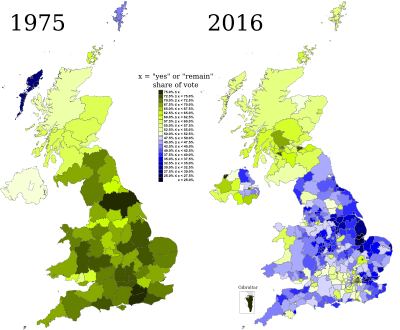
Comparing of results of 1975 and 2016 referendums
In 1979, the United Kingdom opted out of the newly formed European monetary system (European monetary system), which was the forerunner to the cosmos of the euro currency.
The opposition Labour Party campaigned in the 1983 general ballot on a commitment to withdraw from the EEC without a plebiscite.[xiv] It was heavily defeated; the Bourgeois government of Margaret Thatcher was re-elected. The Labour Political party later on inverse its policy.[xiv]
In 1985, the Great britain ratified the Single European Act – the first major revision to the Treaty of Rome – without a referendum, with the total support of the Thatcher government.
In Oct 1990 – under the conservative governance of Margaret Thatcher – the United Kingdom joined the European Exchange Rate Mechanism (ERM), with the pound sterling pegged to a basket of eight other European currencies.
Maastricht Treaty and Plebiscite Party [edit]
Thatcher resigned equally Prime Government minister in November 1990, among internal divisions inside the Conservative Political party that arose partly from her increasingly Eurosceptic views. The United Kingdom was forced to withdraw from the ERM in September 1992, after the pound sterling came nether pressure from currency speculators (an episode known every bit Black Wednesday). The resulting cost to U.k. taxpayers was estimated to exist in excess of £3 billion.[xv] [xvi]
On 1 November 1993, the Maastricht Treaty introduced new concepts such as the euro, a European Central Bank or the European citizenship; it too changed the proper noun of the Customs to the European Marriage reflecting the evolution of the organisation from an economic union into a political wedlock.[17]: the Marriage is founded on the European Communities (first pillar), with two additional areas of cooperation (second and tertiary pillars): the Mutual Foreign and Security Policy (CSFP) and Justice and Domicile Affairs (JHA).[xviii] Every bit a result of the Lisbon Treaty, which entered into force on 1 Dec 2009, the Maastricht Treaty is now known, in updated class as, the Treaty on European Wedlock (2007) or TEU, and the Treaty of Rome is now known, in updated form, every bit the Treaty on the Functioning of the European Spousal relationship (2007) or TFEU.
The Referendum Party was formed in 1994 by Sir James Goldsmith to contest the 1997 full general election on a platform of providing a referendum on the UK'due south membership of the EU.[nineteen] Information technology fielded candidates in 547 constituencies at that election, and won 810,860 votes or 2.6% of the total votes cast.[20] It failed to win a unmarried parliamentary seat because its vote was spread out across the country, and lost its eolith (funded by Goldsmith) in 505 constituencies.[20]
Great britain opt-outs from EU legislation [edit]
Uk opted out from EU legislations.
Role of UKIP (1993–2016) [edit]
The UK Independence Party (UKIP), a Eurosceptic political party, was also formed, in 1993. It achieved third identify in the UK during the 2004 European elections, 2nd place in the 2009 European elections and starting time identify in the 2014 European elections, with 27.5% of the total vote. This was the outset fourth dimension since the 1910 general election that any political party other than the Labour or Conservative parties had taken the largest share of the vote in a nationwide election.[21] UKIP'south electoral success in the 2014 European election has been documented as the strongest correlate of the back up for the leave entrada in the 2016 plebiscite.[22]
In 2014, UKIP won 2 by-elections, triggered by defecting Conservative MPs, and in the 2015 general election took 12.6% of the total vote and held one of the ii seats won in 2014.[23]
Controversy on the European Court of Human Rights in 2013 [edit]
The European Convention on Human Rights (ECHR) was drafted in 1950 and its court (ECtHR) was established in 1953. EU institutions are bound under commodity half dozen of the Treaty of Dainty[ citation needed ] to respect homo rights under the convention, over and above for example the Law of the United Kingdom.[24] The Court was criticised specially within the Conservative Party for ruling in favour of British prisoners obtaining the right to vote.[25] [26] [27] [28] During the referendum the then Home Secretary, Theresa May, had called for the UK to leave the ECHR.[29]
Neither the ECHR nor the ECtHR is formally role of the European union, and are not connected to the Court of Justice of the European Matrimony (CJEU). The ECHR was drafted past, and the ECtHR is part of, the Council of Europe, of which the United kingdom was a founding member in 1949. The UK was an independent signatory to the ECHR, 21 years before joining the EC/Eu, in 1951.[30] However, the European Court of Man Rights (which is the court founded past the European Convention of Human being Rights) does non have ramble supremacy over the various judiciaries of European Countries. The European Court of Justice (which is the courtroom founded by the Treaty on the Performance of the European union) does in fact try to follow the European Convention of Human Rights and the judgements/opinions of the European Court of Human Rights.
Euroscepticism (1993–2016) [edit]
In a statistical assay published in April 2016, Professor John Curtice of Strathclyde University defined Euroscepticism as the wish to sever or reduce the powers of the EU, and conversely Europhilia as the want to preserve or increase the powers of the Eu. Co-ordinate to this definition, the British Social Attitudes (BSA) surveys show an increase in euroscepticism from 38% (1993) to 65% (2015). Euroscepticism should withal not be confused with the wish to exit the EU: the BSA survey for the menses July–Nov 2015 shows that sixty% backed the selection "go along every bit an EU fellow member", and only 30% backed the option to "withdraw".[31]
Since 1977, both pro- and anti-European views have had majority support at different times, with some dramatic swings betwixt the two camps.[32] In the United Kingdom European Customs membership referendum of 1975, two-thirds of British voters favoured connected EEC membership. The highest-ever rejection of membership was in 1980, the start full yr of Prime Government minister Margaret Thatcher's term of function, with 65% opposed to and 26% in favour of membership.[32]
Afterwards Thatcher had negotiated the UK rebate of British membership payments in 1984, those favouring the EEC maintained a lead in the opinion polls, except during 2000, as Prime Minister Tony Blair aimed for closer European union integration, including adoption of the euro currency, and around 2011, as immigration into the Uk became increasingly noticeable.[32] As late equally December 2015 there was, according to ComRes, a clear bulk in favour of remaining in the Eu, admitting with a warning that voter intentions would be considerably influenced by the outcome of Prime Minister David Cameron'south ongoing EU reform negotiations, especially with regards to the two issues of "safeguards for non-Eurozone member states" and "immigration".[33] The post-obit events are relevant.
Plebiscite of 2016 [edit]
On 23 June 2016 the United Kingdom held its second plebiscite on membership of what had now become the European Union. This took place forty one years later the first referendum, which had resulted in an overwhelming vote to remain inside the bloc. The 2nd referendum came about after the Conservatives led by David Cameron won an unexpected small overall bulk in the 2015 UK general election, which included a manifesto commitment to holding a in-out referendum on Britain'due south relationship with the EU post-obit a renegotiation which took place in the autumn and wintertime of 2015–16. At the same time parliament legislated for the referendum by passing the European Marriage Referendum Act 2015. The UK Regime was in favour of a "Remain" upshot, although chiffonier ministers were allowed to entrada on either side in a break of Chiffonier commonage responsibility, just equally ministers had dorsum in 1975. The surprise result of the referendum after a long x-week campaign, with a narrow majority of people (52% for, 48% against) in favour of leaving the EU on a national turnout of 72%, sent shockwaves both throughout Europe and the residue of the globe, causing turmoil in coin markets and stock markets during the following mean solar day. David Cameron appear that he would resign as Prime Minister, and he was succeeded by Theresa May who became Prime Minister on 13 July 2016 to brainstorm the process of the Great britain'due south withdrawal from the bloc.
| Choice | Votes | % |
|---|---|---|
| Leave the European Marriage | 17,410,742 | 51.89 |
| Remain a fellow member of the European Union | sixteen,141,241 | 48.11 |
| Valid votes | 33,551,983 | 99.92 |
| Invalid or blank votes | 25,359 | 0.08 |
| Total votes | 33,577,342 | 100.00 |
| Registered voters and turnout | 46,500,001 | 72.21 |
| Source: Electoral Commission[34] | ||
| Exit: 17,410,742 (51.9%) | Remain: 16,141,241 (48.1%) | ||
| ▲ | |||


Results by United kingdom of great britain and northern ireland voting region (left) and by council commune/unitary dominance (GB) & Great britain Parliament constituency (NI) (right)
Get out
Remain
| Region | Electorate | Voter turnout, of eligible | Votes | Proportion of votes | Invalid votes | ||||
|---|---|---|---|---|---|---|---|---|---|
| Remain | Leave | Remain | Leave | ||||||
| Due east Midlands | 3,384,299 | 74.2% | 1,033,036 | 1,475,479 | 41.18% | 58.82% | 1,981 | ||
| East of England | four,398,796 | 75.vii% | i,448,616 | ane,880,367 | 43.52% | 56.48% | two,329 | ||
| Greater London | v,424,768 | 69.7% | 2,263,519 | 1,513,232 | 59.93% | 40.07% | four,453 | ||
| North East England | 1,934,341 | 69.3% | 562,595 | 778,103 | 41.96% | 58.04% | 689 | ||
| Due north West England | v,241,568 | 70.0% | ane,699,020 | 1,966,925 | 46.35% | 53.65% | 2,682 | ||
| Northern Ireland | ane,260,955 | 62.7% | 440,707 | 349,442 | 55.78% | 44.22% | 374 | ||
| Scotland | 3,987,112 | 67.2% | 1,661,191 | ane,018,322 | 62.00% | 38.00% | i,666 | ||
| South East England | 6,465,404 | 76.8% | ii,391,718 | 2,567,965 | 48.22% | 51.78% | 3,427 | ||
| Due south Westward England (inc Gibraltar) | iv,138,134 | 76.7% | 1,503,019 | 1,669,711 | 47.37% | 52.63% | 2,179 | ||
| Wales | two,270,272 | 71.7% | 772,347 | 854,572 | 47.47% | 52.53% | 1,135 | ||
| W Midlands | iv,116,572 | 72.0% | one,207,175 | 1,755,687 | xl.74% | 59.26% | 2,507 | ||
| Yorkshire and the Humber | iii,877,780 | 70.7% | 1,158,298 | 1,580,937 | 42.29% | 57.71% | 1,937 | ||
Brexit (2017–2020) [edit]
From 2017 to 2019 post-obit the outcome of the referendum, the UK was engaged in negotiations to get out the Eu betwixt the European Spousal relationship and itself. Between the Uk and Eu, the so-chosen "Brexit" – a portmanteau of "United kingdom" and "get out" – would consist of a withdrawal agreement and a merchandise agreement, nevertheless at a global level this would/might besides separate various other free trade agreements. The withdrawal agreement was viewed by the European union as a "settlement of accounts" unrelated to the post-go out trade understanding, and viewed by the UK as a 'goodwill payment' to enable a fair postal service-get out trade agreement. In the event of a no-bargain scenario, each side will consequently have different views as to the validity of any payment.
On 29 March 2017, the then British Prime number Minister Theresa May formally triggered Commodity 50 of the Lisbon Treaty past sending a letter to the then President of the European Council Donald Tusk, which gave the UK and EU 2 years, until 29 March 2019 at 11pm (Uk time) to concur an get out deal. If the two parties were not able to strike an agreement, and Commodity 50 had non been extended, the U.k. would exit the EU without a deal as the default position.
Come March 2019, the Britain was unable to achieve a deal and so, to avoid a no-deal scenario, agreed a bargain with the European union to filibuster Article 50 until 12 Apr – two weeks after the original deadline. This deadline was not reached, and the two parties so postponed the so-chosen "Brexit Day" until 31 Oct 2019. This required Britain to participate in the 2019 European Parliament election. The newly established Eurosceptic Brexit Party, headed by Nigel Farage, made sweeping gains, taking a high percentage of the United kingdom vote.
In July 2019, Theresa May resigned equally Prime number Minister. On 23 July 2019, Vote Leave campaigner Boris Johnson took office as her replacement. Johnson extended the deadline until 31 January 2020, and then called an early on general ballot in December. Johnson and the Conservative Party won a majority of 80 seats. Both the EU and UK Parliaments ratified the Withdrawal Agreement, which allowed the UK to leave the bloc at 11 pm GMT on 31 January 2020. Negotiations on the hereafter UK–EU relationship afterward began in one case the UK formally left the Eu and entered the transition flow.
See also [edit]
- United Kingdom opt-outs from EU legislation
- European Union–U.k. relations
- Opinion polling on the United kingdom of great britain and northern ireland rejoining the European Spousal relationship (2020–present)
- Opinion polling on the U.k.'s membership of the European Matrimony (2016–2020)
- Post-Brexit Britain relations with the European Union
References [edit]
- ^ Tognina, Andrea (2 April 2019). "How the Swiss and Brits accept dealt with Europe". SWI swissinfo.ch. Archived from the original on 13 July 2019. Retrieved 13 July 2019.
- ^ "1967: De Gaulle says 'non' to U.k. – again". BBC News. 27 November 1976. Archived from the original on ii Feb 2019. Retrieved ix March 2016.
- ^ Georgiou, Christakis (April 2017). "British Capitalism and European Unification, from Ottawa to the Brexit Referendum". Historical Materialism. 25 (1): ninety–129. doi:10.1163/1569206X-12341511. Archived from the original on 15 December 2019. Retrieved fourteen September 2019.
- ^ FCO thirty/1048, Legal and ramble implications of Britain entry into EEC (open from 1 January 2002 under the 30-year rule).[1] Archived 2019-07-05 at the Wayback Machine
- ^ "Into Europe". Parliament.uk. Archived from the original on 28 March 2019. Retrieved 25 February 2017.
- ^ "English text of EU Accession Treaty 1972, Cmnd. 7463" (PDF). Archived from the original (PDF) on 21 Dec 2016. Retrieved 24 Feb 2017.
- ^ "1973: U.k. joins the EEC". BBC News. one Jan 1973. Archived from the original on 14 January 2019. Retrieved nine March 2016.
- ^ Alex May, Britain and Europe since 1945 (1999).
- ^ "1975: Labour votes to go out the EEC". News.bbc.co.uk. 26 Apr 1975. Archived from the original on 12 December 2018. Retrieved 31 January 2019.
- ^ Davis Butler. "The 1975 Referendum" (PDF). Eureferendum.com. Archived from the original (PDF) on 15 August 2016. Retrieved 19 May 2016.
- ^ "Research Briefings – The 1974–1975 UK Renegotiation of EEC Membership and Referendum". Parliament of the United Kingdom. Archived from the original on 26 April 2019. Retrieved 19 May 2016.
- ^ "Who Voted for Brexit? A comprehensive district level analysis". Becker, Fetzer, Novy, Academy of Warwick. Archived from the original on one April 2019. Retrieved 22 November 2016.
- ^ Vaughne Miller, Enquiry Briefings – The 1974–75 Uk Renegotiation of EEC Membership and Referendum, Firm of Eatables Library, parliament.uk, 13 July, 2015, accessed 4 July 2021
- ^ a b Vaidyanathan, Rajini (4 March 2010). "Michael Foot: What did the 'longest suicide note' say?". BBC News Magazine. BBC. Archived from the original on 2 September 2017. Retrieved 21 Oct 2015.
- ^ Dury, Hélène. "Black Wednesday" (PDF). Archived (PDF) from the original on i October 2018. Retrieved 24 February 2016.
- ^ Tempest, Matthew (9 February 2005). "Treasury papers reveal toll of Black Wednesday". The Guardian. London. Archived from the original on 12 December 2019. Retrieved 26 April 2010.
- ^ "EUROPA The EU in brief". Europa (web portal). Archived from the original on 26 July 2016. Retrieved xix May 2016.
- ^ "Maastricht Treaty". Archived from the original on 2021-10-15. Retrieved 2021-ten-eleven .
- ^ Wood, Nicholas (28 November 1994). "Goldsmith forms a Euro referendum party". The Times. p. 1.
- ^ a b "UK Election 1997". Politicsresources.net. Archived from the original on 21 September 2011. Retrieved 16 July 2015.
- ^ "10 key lessons from the European election results". The Guardian. 26 May 2014. Archived from the original on 27 May 2014. Retrieved 31 May 2014.
- ^ "Does Migration Cause Extreme Voting?" (PDF). Becker and Fetzer, Academy of Warwick. xviii October 2016. Archived (PDF) from the original on xiv November 2016. Retrieved thirty November 2016.
- ^ Matt Osborn (7 May 2015). "2015 United kingdom general election results in full". The Guardian. Archived from the original on 13 September 2019. Retrieved vii July 2017.
- ^ "Why are the Conservatives against the European courtroom of human rights?". Guardian newspapers London. fourteen July 2014. Archived from the original on vi May 2017. Retrieved half-dozen May 2017.
- ^ "European court is not superior to UK supreme courtroom, says Lord Judge (the erstwhile Lord Chief Justice of England and Wales)". The Guardian paper, Londion. 14 Dec 2013. Archived from the original on 19 October 2017. Retrieved half dozen May 2017.
- ^ "David Cameron to 'scrap' Human Rights Deed for new 'British Pecker of rights'". Independent Paper, London. 1 October 2014. Archived from the original on one May 2017. Retrieved 6 May 2017.
- ^ "Human Rights Act versus a British Beak of Rights". British Broadcasting Corporation, Newsbeat study, London. 25 May 2015. Archived from the original on v September 2017. Retrieved 6 May 2017.
- ^ "Plan to scrap Human Rights Act delayed over again". Guardian Newspapers London. two December 2015. Archived from the original on xix Jan 2017. Retrieved 6 May 2017.
- ^ "UK must leave European convention on human rights, says Theresa May". Guardian newspapers London. 25 April 2017. Archived from the original on eighteen May 2017. Retrieved 6 May 2017.
- ^ "BBC News | U.k. | Human Rights: The European Convention". news.bbc.co.united kingdom of great britain and northern ireland. Archived from the original on 2009-04-04. Retrieved 2018-10-29 .
- ^ Tarran, Brian (8 April 2016). "The Economy: a Brexit vote winner?". Significance. 13 (2): half dozen–7. doi:10.1111/j.1740-9713.2016.00891.x.
- ^ a b c Mortimore, Roger. "Polling history: 40 years of British views on 'in or out' of Europe". The Conversation. Archived from the original on 3 April 2019. Retrieved 25 Oct 2016.
- ^ New Open up Europe/ComRes poll: Failure to win fundamental reforms could swing U.k.'southward European union referendum vote Archived 2018-06-15 at the Wayback Machine openeurope.org, sixteen December 2015.
- ^ "Eu referendum results". Electoral Commission. Archived from the original on xxx June 2019.
cramptonthermisen.blogspot.com
Source: https://en.wikipedia.org/wiki/United_Kingdom_membership_of_the_European_Union
0 Response to "Is Uk Part of Eu Again"
Post a Comment